
The Last Rites of Benjamin Hill
(c) John C. Prejean Sr. / March 8, 2026
I
The blood kept soaking through the makeshift bandage. Ben did his best to keep pressure against his belly, but the blood soaked through all the same. The Arizona sun bore down on him. The trickles of sweat ran down his forehead, mixing in with the dust of the trail, falling into his eyes, the salt from it burning them. He was a rail of a man—barely five foot nine and no more than a hundred and thirty-five pounds soaking wet, and although at twenty years of age, he’d been living a life of crime for years, he was still green, a boy really, a mere child who had foolishly mistaken bravado for wisdom. He took a shot at bank robbing, which had proved him wrong, and now, he was paying for it.
He staggered along the dry riverbed, each step weaker than the last, struggling with the sand until his legs failed him. He could walk no more. His legs quivered and shook. As he desperately looked around, there was no shade to be found, only a lonely mesquite bush clawing at the dust from the edge of the dry riverbed, offering a measly shadow from its thin branches. He lowered himself as best he could, finally collapsing to the ground, knees first. The impact sent a lance of pain through him, sharp enough to draw a loud cry from his parched throat. He clenched his jaw and fought the pain, finally sinking into the sand, his breath ragged, the heat and the pain pressing in on him like a posse he could no longer outrun. The impact of the drop made the blood from his wound pour out worse than before. He packed some sand into the wound in a desperate attempt to stop the bleeding, each pressing of earth sending a searing bolt of pain through his body, until finally it stopped. He lay back on the sand in exhaustion.
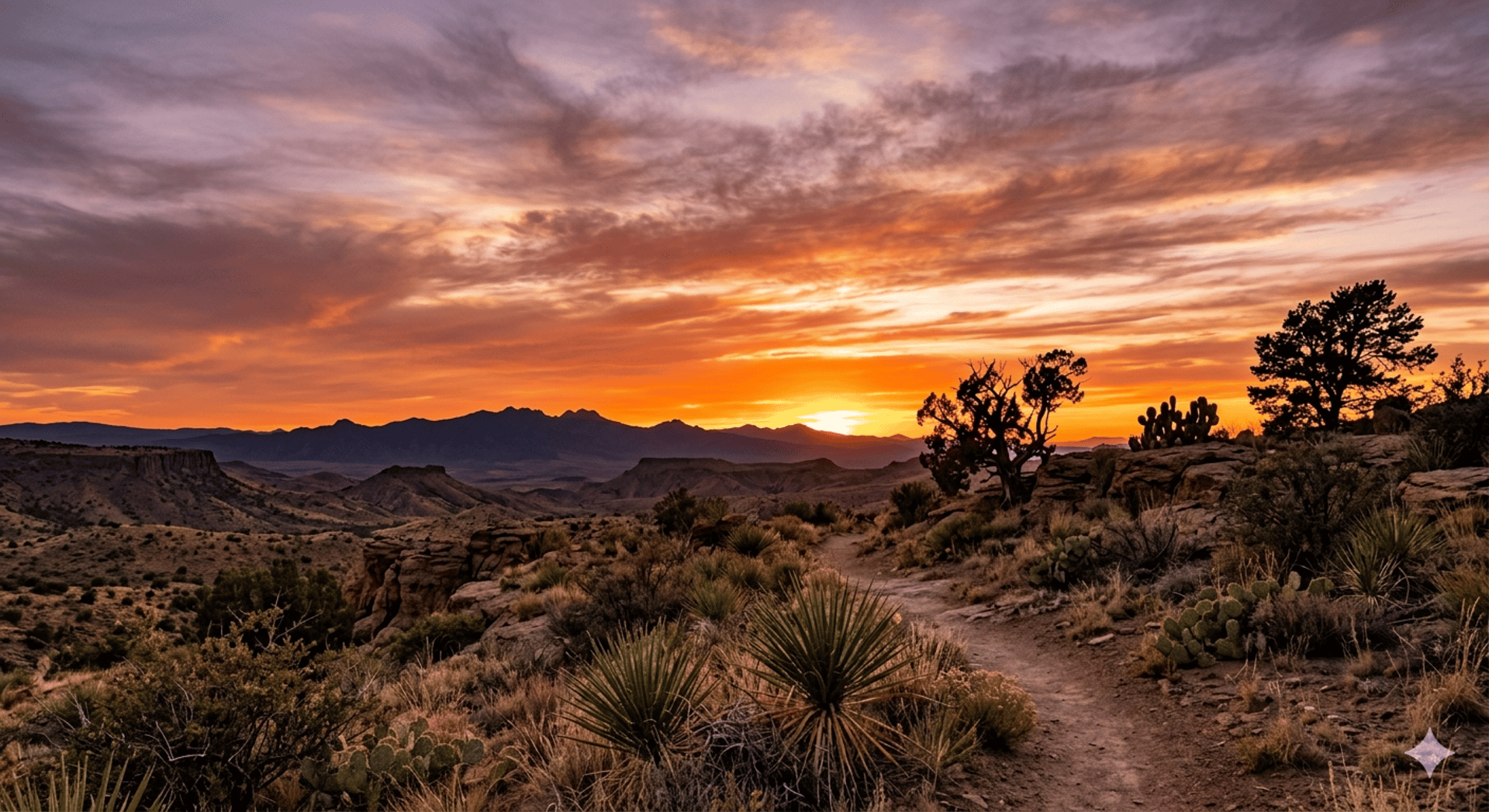
He must have passed out, for when his eyes opened again, the sun was sinking low, the sky was bruised with purple and amber hues. His mouth was thick with thirst, and he tipped his canteen, swallowing the last measly drops it had to offer. Empty now, he let it fall from his hand to the sand below; the hollow clank echoed in his head. Right then, the truth of his condition settled on him suddenly, heavy and inescapable. He knew that death was on its way. His shoulders shook as he wept—not loud, not wild, but with the slow, broken sorrow of a man who at last understood how little time he had left. He looked in all directions for his horse but didn’t see it. He couldn’t remember the last time he did. His surroundings were starting to blur, brought on by the fever and pain.
He forced himself upright, unwilling to lie there and become an easy meal for coyotes or whatever else prowled the desert after dark. With all the strength he could muster, he hauled his body out of the dry riverbed and onto the cracked Arizona earth, each movement an act of defiance against the pain and death. He knew that he was dying, but refused to die out there in the desert. He turned south and walked, knowing that Mexico lay somewhere ahead—a place he prayed might offer refuge and a miracle chance at life.
He walked for hours, or so he thought, certain he had covered ten miles when in truth he had scarcely made two. His feet dragged through the dust, each step slower than the last. He felt as though the land itself were trying to claim him. Above him, the moon burned a bright white, and the stars looked on, giving him enough light to make his way. But now the blood—the blood started flowing, seeping through the sand he had packed in, and his strength dwindled to almost nothing.
As the night sky and the land before him swirled as if he were in a drunken state, his legs failed him. He fell hard and rolled onto his back, the ground still warm beneath him, holding the day’s heat like a dying breath. He stared up at the evening sky, and his thoughts wandered back to his childhood, to the years before everything had gone wrong—before his father left him and his mom, and the house grew bitter and cold. His mother’s voice still haunted his mind. Her voice sharp and condemning as ever: You’ll never amount to anything, just like your worthless father. He had been little more than a boy when she said it, eleven years old. That was the day he refused to remain there, a whipping post for his mother. So he left home. He stared at the stars, swirling in every direction, the memories weighing heavier than his wound, and then the night closed in. Everything went dark.
II
Only two days earlier, he had been in Tombstone—a weathered mining town in southeastern Arizona, a town with sun-scorched streets and an even harder reputation. From across the street, he kept his eyes on the bank, its stone façade hunched and reverent like a chapel, though no grace waited behind its doors. He marked each man who passed, saw how their fingers rested close to their guns, judging the space between them the way a man measures the cost of sin.
The waiting wore on his patience; he crossed into the saloon next door. The place smelled of sweat, smoke, and stale spilled whiskey. An image of hell quickly entered and left his mind. He ordered a plate of food and a whiskey, hoping the burn from it would quiet the unease in his chest. As he ate, his back to the door, a voice rose behind him, low and knowing, and it made the hair on the back of his neck rise.
“I seen you checkin’ that bank.”
The stranger pulled out a chair and sat close, uninvited. “I’m fixin’ to hit it too,” he said. “We should do it together. Split the take and spare ourselves some trouble.”
Ben studied the man in silence. He was well along in years—fifty, maybe sixty—with long gray hair hanging loose and a scraggy gray beard, stained dark from tobacco spit. His eyes, hard to see past the hanging hair, were dull but practiced. They were the eyes of a man who had walked this road before and knew exactly where it led. There was something about the man, though, something that Ben couldn’t shake. He looked more like a warning instead of a partner, as if the future had taken a seat beside him and was waiting to see what choice Ben would make.
Ignoring the thought, he turned the proposal over in his head as he ate, keeping to himself and giving the stranger no answer. It would be easier hitting the bank cleanly with two of them instead of himself. When he finally lifted his eyes, he saw the man more clearly and felt an icy chill settle in on him. The stranger’s right eye was dead—no patch, no shame—just a milk-clouded orb fixed on him, unblinking, as though it saw something Ben could not. His soul.
At last, Ben spoke. “You follow my lead. We do this my way! You got it!” He wiped his mouth with a napkin and dropped it onto the plate, leaving the rest untouched. The old man wiped the hair from his face, the dead eye still staring through Ben. “No problem.” He said.
They got up and stepped out of the dark saloon into the glaring sun of the day. At the door, Ben paused and leaned in towards the stranger, his voice lowered to a murmur. “You head that way, across the street near the bank. I’ll go back to where I was. Meet me at the bank at half past three. You do know how to tell time, don’t ya?”
The stranger looked at him then, the blind eye catching the light, hard and wrong. “Yup,” he said, with a sly, evil smirk, and turned away, the sound of his boots carrying away in the distance.
The hour arrived sooner than Ben expected. At half past three, he and the stranger stepped into the bank together, faces hidden behind knotted handkerchiefs. Inside, there was a lone customer and the teller; the room was quiet enough to hear the ticking of the clock on the wall. The stranger locked the door as Ben moved to the counter. “This is a stickup,” he said, his voice steady despite the nerves in his chest. “Hand it over quick, and no one gets hurt.” The Colt in his hand was trained squarely on the teller.
The lone patron—an elderly woman—caught sight of the gun, fainted, and crumpled to the floor without a sound. The teller’s hands shook as he filled four heavy sacks with bills and gold and slid them across the counter, his face ashen white with fear.
It was over as quickly as it began. They gagged and tied up the teller and the old lady. They took the bags and hightailed it out of town, riding hard as though distance alone might absolve them of what they had just done.
III
After they’d put some distance behind them and Ben was certain that no one was on their trail, he eased his horse down to a steady trot. “Where to now?” he asked.
The stranger slowed and turned in the saddle. The ruined eye caught the last of the daylight, shining pale and lifeless, while the good one held a knowing depth that unsettled Ben. A crooked smile tugged at his mouth as he raised a finger and pointed ahead.
“That rise is called Purgatory Hill. That’s where we are headed.”
Ben followed the line of the stranger’s gesture. The land rose abruptly from the flats, a dark hump of stone and scrub clawing at the sky. The earth there looked scorched and broken, as though nothing had ever grown willingly upon it. Even the wind seemed to shy away, curling low and whispering through the rocks like a breath half-swallowed. An aptly named location.
The stranger went on, “There’s a cave close by. We can hole up there, stash the take, and lie low for a few days.” His voice carried an ease that felt practiced, too practiced and too calm for what they had done, as if he had led men this way before.
The hill seemed to loom larger the longer he stared at it, less of a place to hide and more like a final reckoning. Every instinct told him to turn back and ride another way, to put daylight between himself and both the hill and the man beside him. Still, he said nothing. He turned his horse and followed. The stranger’s horse moved ahead without urging, finding the path as though it knew it well, and Ben rode behind him, the distance between them closing like a narrowing gate.
When they reached the mouth of the cave, the stranger fished a crude torch from a ledge outside the entrance and lit it. The flickering flame painted the rocks in restless shadows, and Ben knew without a doubt that the man had been here before. He followed silently as the stranger led them deep into the cave, the walls narrowing, roughly hewn, the air growing cooler and heavy with the scent of earth and stone.
“Put the loot over in that crack at the rear of the cave,” the stranger said, gesturing toward a jagged split near the back. Ben carried the bags and tucked them into the dark, broken wall, letting them drop to the floor where the shadows swallowed them whole.
When he turned back, the stranger had his rifle pointed at him. The torchlight danced in the clouded eye, making it blaze like a piece of burning coal in the darkness. For a moment, Ben swore it was less of a human gaze and more of a demonic stare, a judgment incarnate, peering straight into his soul. The air thickened, heavy with the scent of damp stone and something fouler, the iron tang of blood spilled long ago.
Ben’s hands shook. The weight of the stolen gold had robbed his fingers of their sense. He wanted to speak, to ask why, to plead, but no words would come out. The stranger’s mouth curved into that crooked, patient smile, and in it Ben thought he saw the shadow of every misdeed he had ever committed—every lie, every theft, every choice that had brought him to this moment.
The rifle did not lower; the walls of the cave seemed to close around him. The flickering torch cast shadows on the walls that writhed and breathed, like dancing demons bouncing off the stone. Ben realized, with a cold certainty, that leaving this place would not free him from what had been set in motion. The darkness inside the cave—and inside himself—was waiting, and it would not be denied. Damnation had arrived; it was time to pay his dues.
A flame erupted from the stranger’s rifle, the shot echoing through the cave, bouncing off the walls like a thunderclap. An immense pain exploded in Ben’s gut, and he gritted his teeth, instinctively drawing his Colt and shooting. The bullet found its mark in the middle of the stranger’s forehead, and he fell, the torch clattering to the stone floor and sputtering out, leaving only darkness and silence where fire and life had once been.
Blood ran hot and heavy down Ben’s side, but he forced himself upright, gripping the wound with one hand as he staggered toward the cave’s mouth. The night spread before him, vast and indifferent, the desert air tasting of dust, ash, and blood. He gazed south toward Mexico, the hope of sanctuary a distant light against the dark horizon. The loot could wait.
IV
The old priest scanned the open plain, his eyes straining for the lone black sheep. He spotted it, off past the mesquite and sagebrush, wandering too far from the fold. The morning sun warmed his aching bones, and the desert air, dry and fragrant, filled his lungs like a blessing.
“There you are,” he said softly as he drew near. “Always straying from the rest of the flock.” He tapped the little sheep gently with his staff, guiding it back toward the others.
Then something on the ground caught his eye—a figure lying face down, blood soaking into the cracked earth as if it were owed a due. The priest’s heart tightened. He rushed over to the man and knelt beside him, seeing the wound and feeling the faint, uneven pulse. Ben was still alive, fragile as a candle flame in the desert wind, clinging to life by sheer stubbornness and will.
The old priest returned to his flock, where his patient burro waited, its ears twitching in the morning light at the sight of the old priest's return. He led the burro back to the wounded man and carefully tied a rope around his chest, enough to let the burro bear the weight of his injured body. The priest was too old and not strong enough to lift the wounded man onto the burro. This was the only way that he could get him back to his place. Before setting off, he wrapped a crude bandage around the gunshot wound, hoping it would hold through the slow trek to Naco.
He led the burro with steady hands, the little black sheep and the rest of the flock following close behind. Dust stirred around them with each dragging step, and the priest kept a careful eye on Ben, adjusting the rope when it threatened to slip, murmuring soft words of encouragement and prayer under his breath. Step by step, the small procession moved toward town, a quiet act of mercy in the vast, indifferent desert.
They reached the old adobe church, its whitewashed walls quiet against the desert sky. The priest gently lifted Ben from behind the burro, took him inside, and laid him on the narrow bed in his casita next to the church. He moved quickly, boiling water and then heading out to fetch the local curandera.
Ben lay fevered and delirious, his mind drifting back through years long past, to the rare moments of warmth in his childhood—before his father left him and his mother, and he followed suit, trying to outrun the emptiness.
When he stirred and opened his eyes, an old Mexican woman leaned over him, damp cloth in hand, murmuring softly to the priest as she wiped his brow. Exhaustion claimed him again almost immediately, as he passed out from the pain.
“There is nothing I can do. He is dying,” the woman said, her voice low, trembling with sorrow. “These hierbas and some wine will help ease the suffering,” she continued.
The priest guided her to the door, thanking her and blessing her before she stepped back into the sunlit courtyard. He returned to Ben, carrying a small basin of water and a vial of oil, placing them carefully on the bedside table. He knelt beside the boy, preparing to perform the anointing of the sick, a sacrament of mercy and grace in the shadow of death.
V
Just as the priest prepared to perform the sacrament, Ben stirred, a fleeting moment of clarity breaking through the haze of pain. His body throbbed where the bullet had struck, and visions danced in his mind like mirages over the desert sand.
“Where… am I? Who… are you?” he croaked.
The priest brushed the sweat from his brow with gentle hands. “You are safe. You are in Naco. I am Padre Infante. You have been shot.”
Ben’s mind went back to the moment in the cave; fire exiting the rifle barrel and the impact of the bullet. His eyes widened with fear and resignation. “Am I… dying?”
Padre Infante’s gaze softened, somber and steady. “Sí. The local medicine woman could do nothing more. She gave me these herbs to mix with wine. Take a sip, it will help with the pain.” He held Ben’s hand, offering both comfort and truth. Ben refused the wine mixture.
After a pause, he asked quietly, “What is your name?”
Ben’s cracked lips moved weakly toward the water beside him. Padre dipped a clean cloth and pressed it gently to his mouth. “Slowly. Sip it slowly,” he instructed.
Ben drew in the water, and after a moment of struggle, he looked up at the priest. “Ben… Benjamin Hill,” he whispered.
The padre kept hold of Ben’s hand and asked gently, “Have you been baptized, Ben?”
Ben jerked his hand away, his breath turning ragged. “No!” he rasped. “I… never had much use for God. Seems he never had much use for me, neither!”
Padre Infante smiled. “God has always had a use for you, Ben,” he said quietly. “And He still does.”
Ben let out a weak, broken laugh, certain the fever was playing tricks on him. “What could he want with me?” he said. “I’m dying. And from what little I know about him, he wouldn’t take a man like me. I’m a sinner. I’ve lived wrong all my life—nothing but thieving, violence, blood and evil.” His voice trembled. Then a look of fear overtook him. “That man…that wasn’t just a man who shot me. I saw it in his eye. That was the devil himself. And now he’s come to claim what’s his.”
A tear slipped from the corner of Ben’s eye as he turned his face away, ashamed to meet the priest’s gaze, afraid of what might still be waiting for him beyond the pain.
Padre Infante took Ben’s hand again, his grip steady—firm with purpose, gentle with mercy. “God desires you to be with Him,” he said quietly. “He calls you home, to a place beyond pain and fear.” Ben looked into the priest’s eyes as he continued to speak.
He dipped the cloth once more into the water and touched it to Ben’s lips. “Every man is born bearing sin,” the padre went on. “It is the inheritance of our kind. God grants us free will—not so we may never fall, but so that we may choose to rise. You chose your own road, Ben, and it has led you here, to death’s doorstep. Now you may choose again.”
Ben’s eyes brimmed, the tears spilling freely now. “I’ve done too much wrong,” he whispered. “Too much to be forgiven. Why would God want a man like me?”
Padre Infante dipped the cloth into the wine mixture this time and pressed it gently to Ben’s mouth, hoping the warmth might ease his suffering. “Do you remember the parable of the lost sheep?” he said softly. “The one that strayed so far it could no longer find its way back. That is when the shepherd went looking—not to punish it, but to carry it home.” He smiled then, a smile worn smooth by years of faith. “I did not find you by chance, Ben. God did. I am only the hands He chose to use.”
“But I’m dying,” Ben said, his voice barely more than a breath. “I can’t be saved.”
The padre shook his head, still smiling. “Your body, no. But your soul—your soul is very much within reach.”
VI
Ben lifted his gaze to Padre Infante, eyes desperate and earnest. “Padre… I want to confess my sins. I want to tell God I’m sorry for all the wrong I’ve done. I want… I want to spend eternity with Him, in heaven—not in hell.”
The padre’s face softened into a gentle, knowing smile. He rose, moving to the other side of the room, and lifted his purple stole from the table. He kissed the end of it reverently before draping it around his neck, then returned to Ben’s side and knelt beside him.
“We will begin with baptism,” he said quietly, his hands steady. “I baptize you in the name of the Father, and of the Son, and of the Holy Ghost. Amen.”
Then, with the same reverence, he continued with confirmation. “Benjamin Hill, be sealed with the gift of the Holy Ghost.” He anointed Ben with the sacred oil, tracing the sign of the cross upon his forehead.
Padre Infante’s voice softened, almost to a whisper: “Are you ready to confess your sins, Ben?”
Ben’s eyes met the padre’s, solemn and unwavering. “Yes, Padre. I am ready.”
Ben took a shuddering breath and began, his voice low and ragged. “I’ve robbed banks… held people at gunpoint… taken what wasn’t mine. I’ve lied, cheated, and killed… and not just once. So many times… I can’t even count them anymore. I’ve hurt people… innocent people… and for what? For money, for pride, for fear. I’ve lived for nothing but myself.”
He paused, tears slipping down his sunburned face, mixing with the sweat and grime of the desert. “I’ve hated… so many… I’ve let anger rule me, let greed and fear lead me… and I’ve thought I could walk away from it all. But I can’t. I can’t escape what I’ve done. I’ve sinned so deeply, Padre, I… I don’t know if I deserve mercy. I don’t even know if I deserve God’s forgiveness.”
He looked up then, trembling, clutching the padre’s hand. “And there’s… there’s one more. The man who shot me. I saw him, Padre… his eye… it was the devil himself staring at me. I… I don’t know if I was meant to die then… or if I was meant to live to face the truth of who I am. I’ve sinned so much. I’ve run too far. But… I want to… I want to be made right before I go. I want… I want God to know I am sorry. Truly sorry.”
Padre Infante squeezed his hand gently, nodding with quiet understanding. “God hears you, Benjamin. He has always heard you. Every wrong, every sin… it is not beyond His mercy. Speak it all, child. Let it go. He waits for your heart to turn fully to Him, now and always.”
Ben closed his eyes, trembling, and let the words tumble out, each confession a small torch in the dark, each one laying his soul bare before God and the padre who bore witness.
VII
Padre Infante listened patiently as Ben poured out his sins, each word shaking the foundation of Ben’s soul. When Ben’s voice faltered, the padre whispered a prayer under his breath, asking God to meet this lost soul where he lay. Then he spoke clearly, “Benjamin Hill, by the power granted to me through Jesus Christ and his Church, I absolve you of all your sins, past and present. In the name of the Father, and of the Son, and of the Holy Ghost. Amen.”
Ben’s shoulders relaxed a bit, as if a weight had been lifted, though the pain in his side still burned. Padre Infante dipped his thumb into the consecrated oil for the sacrament of the sick. He anointed Ben’s forehead and hands, making the sign of the cross carefully, “Through this holy anointing, may the Lord in His love and mercy strengthen you, body and soul. May he forgive your sins, comfort you in your suffering, and grant you eternal rest in His Kingdom.”
As Padre Infante finished the anointing of the sick, he remained kneeling by Ben, his hand still resting gently over Ben’s. The room was quiet, except for the shallow sound of Ben’s labored breathing and the distant whisper of the wind through the desert mesquite.
“Benjamin,” Padre Infante said softly, “there is one more sacrament you must receive.” Padre reached into a small wooden box on the bedside table and took out the consecrated host. It gleamed in the sunlight coming through the window, pale and pure. Ben’s eyes widened, a mix of wonder and fear in their depths. “What…is that Padre?” he asked, his voice trembling. “This is the Lord, Jesus Christ.” Padre Infante said, his voice full of gentle reverence. “He comes to you now in the form of bread. He has been waiting for you, Benjamin. He forgives. He loves. He brings eternal life to the soul.”
Tears welled up in Ben’s eyes, blurring the room, and for the first time in years, his heart felt light. The pain in his body remained, but the weight of his sins, his fear, and his despair drifted away with the desert breeze.
“Receive your First Holy Communion, Benjamin.” Padre Infante said as he held the host over Ben’s mouth. “The Body of Christ,” he continued. Ben responded, “Amen,” and opened his mouth. As the sacred host touched his tongue, a sensation of warmth flooded his body, like sunlight breaking over the desert sand after a long night. His heart filled with the most intense joy he had ever felt. He closed his eyes, tears spilling freely down his face, and whispered, “Thank you. Thank you, Lord Jesus Christ.”
Padre Infante smiled, tears welling up in his eyes as they glimmered with quiet joy, “Welcome to the banquet of the Lord, Benjamin. You are his now, body and soul.”
For a long moment, Ben lay there, tasting the grace of God, feeling for the first time in his life what it meant to be truly loved, forgiven, and held. Outside, the desert seemed to hold its breath, and the flock of sheep stirred as if witnessing a miracle. Ben’s tears of joy mixed with the sweat and dust of his desert journey, and for the first time, he felt at peace. His soul had finally been made right with God.
His breathing slowed, the fever overtaking his body. Padre Infante stayed beside him, gently holding his hand while offering silent prayers. The sun was climbing higher, allowing more light to shine into the whitewashed room. The little black sheep entered and rested at the feet of Padre Infante, quiet and watchful, as if keeping vigil.
Ben opened his eyes, seeing the padre’s kind, unwavering gaze. “Thank you, Padre,” he whispered, his voice barely recognizable. “I…I think…I understand now. I…am not alone.” Padre Infante nodded, tapping Ben’s hand with reassurance, “You were never alone, Benjamin. God has always been with you, even when you could not see him. Now, rest in His peace, Benjamin.”
Ben’s breathing faltered, each rise of his chest gentler than the last, until even the pain seemed to loosen its grip. Padre and the little black sheep continued keeping watch, Padre praying in silence as the breeze blew in through the window. Outside, the wind and the sheep settled as the heat of the day began to disappear. Ben’s face, once hardened by fear and regret, rested now in quiet peace. When his final breath came, it left without a struggle, as if he were simply laying down a long, burdensome load. Padre Infante made the sign of the cross on Ben’s forehead and whispered a prayer for the dead. In the vast desert that had nearly claimed him, Benjamin Hill was finally found and carried home.
(C) 2026 Wild West Catholic-Catholic Western Fiction. FAITH--VIRTUE--GRIT


